Our commitment to sustainability is operationalized in our Sustainability Strategy and its different components throughout the investment process
The investment process
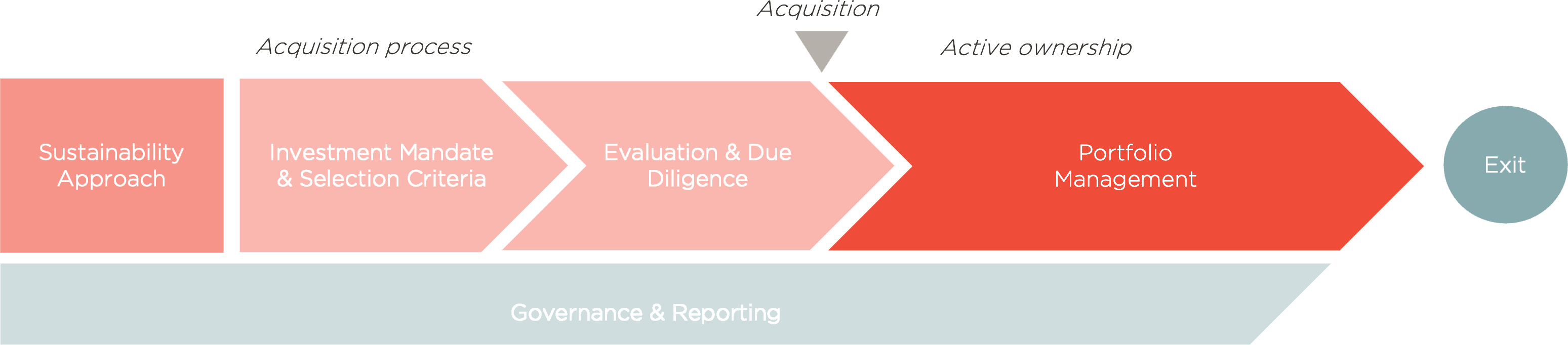
Sustainability Approach
Outlines how we are working with sustainability and what sustainability means for our investment strategy and process. Our approach also details our focus areas and the international standards and frameworks that we are basing our work on.
Acquisition process
With our Sustainability Approach as the starting point, sustainability is an integrated part of our investment process. Our Investment Mandate & Selection criteria define what we are willing to invest in and how we screen investment opportunities. Our process for Evaluation & Due Diligence dictates how we evaluate investments prior to an acquisition.
Portfolio Management
Our Portfolio Management process outlines how we are working with sustainability in partnership with our portfolio companies as part of our active ownership. Our ‘Polaris Sustainability Program’ help our companies define the appropriate strategy and is an integrated part of Polaris Excellence Model, which supports value creation in our portfolio companies.
Governance & Reporting
Details how sustainability fits into our overall governance structure, from defining our approach and throughout the acquisition process and active ownership phases to how we measure, track our progress, and communicate around sustainability.

Our Sustainability Approach
Our commitment and rationale
As the fund manager of Polaris’ funds, we at Polaris Management acknowledge that our responsibility stretches beyond our own organization and includes the broader impact we have on all stakeholders of Polaris: the employees, customers, suppliers, and the societies where we and our portfolio companies operate. We are committed to actively promoting sustainability throughout Polaris and do this for two reasons:
- It is a moral imperative – it is the right thing to do
- It is an integrated part of long-term value creation
We promote sustainability by
- Promoting sustainability throughout Polaris and incorporate sustainability considerations into our own operations in Polaris Management as well
as in our investment and portfolio management processes for each of our investment strategies. This is our Sustainability Strategy. - Striving to continuously improve the way we work with sustainability and our sustainability performance both as investors, in our work with our portfolio companies, their management teams and Board of Directors, as well as in Polaris Management.
- Being transparent and reporting on our performance and progress in this Sustainability Report which we publish on an annual basis.
- Working with, and thereby promoting, internationally recognized sustainability standards
- Actively engage in promoting sustainability and transparency around sustainability in the finance sector where we operate.
Our scope
Our sustainability approach sets the direction for our work in Polaris Management. However, as a fund manager, we believe that our main positive, as well as negative, impacts on sustainability derive from the collective actions of our portfolio companies. Therefor, we believe that it is key that all our work with sustainability is integrated in the ongoing work with our companies to promote concrete actions at portfolio company level.
Our approach to sustainability is founded on recognized international standards and concepts and based on these, we have developed an approach to how we believe sustainability should be approached for mid-sized Nordic companies. We call this 'Polaris Sustainability Program'. The program is tailored to allow for company specific considerations and to ensure the most relevance and impact for each company. This is based on our belief that the material sustainability related risks and opportunities are often unique for each sector and often also specific for each company depending on their maturity as well as geographic location, supply chain, business model and culture. For our work to be relevant we must continuously ensure that our sustainability strategy strikes the right balance between standards and minimum requirements and company specific considerations, including maturity, resource availability and ambition level. Our program is well tried and tested in our private equity strategy where we have majority control and it is continuously developed. The program also informs our due diligence process and investment mandate.
Our approach is very well aligned with the main principles of the Corporate Sustainability Reporting Directive (CSRD), Double Materiality Assessment (DMA) and reporting. This means that company efforts to prepare for this reporting will at the same time fulfill many of the requirements inherent in ‘Polaris Sustainability Program’ and the other way around.
Our sustainability strategy described in this report is implemented in our work at Polaris Management A/S as a fund manager and investor. The strategy is then operationalized for each of our active investment strategies per the 31st of December 2024 and their respective funds:
- Polaris Private Equity (PPE): Majority equity investments
- Fund IV launched in 2015
- Fund V launched in 2021
- Polaris Flexible Capital (PFC): Minority equity and junior debt
- Fund I launched in 2021
- Polaris Public Equity (PPU): Minority investments in listed companies in the Nordics
- Fund launched in 2023
The active funds managed under these strategies fall under SFDR – Article 8. Our work at Polaris Management level and for each strategy is further detailed in our publicly available Responsible Investment Policy (RIP).
In March 2025, we also assumed the management of the fund now named Polaris CS Fund I K/S from Core Sustainability Capital A/S. This fund is a SFDR – Article 8 fund and the equity and debt investments in the fund are managed by the investment teams of PPE and PFC.
Sustainability standards
To create a solid foundation for our work with sustainability, our Sustainability Strategy is based on, and aligned with, recognized international standards and regulations. With this approach we seek to ensure that we cover both financial and impact materiality, in a consistent and reliable way in our reporting and that we support strengthened reporting practices and the development of common standards in the investment community with respect to sustainability.

Since 2017, we have founded our work with sustainability on UN’s Guiding Principles and OECD’s guidelines defining responsible business conduct. The standards cover social (human rights including labor rights), environmental and economic (including anti-corruption) impacts. The management standards are referred to as our Sustainability Principles and form the basis for managing impacts. Before an acquisition, all potential investments’ compliance towards the Sustainability Principles are evaluated and all Portfolio Companies in the private equity strategy are also consequently taken through a comprehensive process to align with these principles. Polaris Management and most of our portfolio companies in Polaris Private Equity are therefore also members of UN Global Compact and work according to these principles. The management system we help implement includes:
- A policy commitment to continuously manage adverse impacts and require the same from business relationships
- A definition of key elements of sustainability: a clear definition of the areas for potential adverse impacts related to:
- Social sustainability (48 areas)
- Environmental sustainability (20 areas)
- Economic sustainability (16 areas)
- Due diligence methodology: a process for assessments of potential and actual adverse impacts throughout the business as well as a first 'Impact Assessment' if the companies own impacts and impacts across the value chain
- Grievance mechanisms: processes for providing access to remedy to impacted stakeholders
- Management process: a governance process for continuously assessing and managing adverse impacts and requiring business relationships to do the same
The EU regulations part of the EU Green Deal, the SFDR, CSRD, the upcoming CSDD and the EU Taxonomy, all reference this management system, and our Sustainability Principles, and have integrated them in the regulatory framework.




Polaris’ sustainability focus areas
Polaris has identified three areas within sustainability that form the main pillars of our sustainability focus. For each focus area we have formulated a cross-portfolio KPI that we work to apply across all investment strategies and portfolio companies. In the private equity strategy, the KPIs are reported on both at fund level, individually at portfolio company level and for Polaris Management. In our work as active owners, we at Polaris Management will make an extra effort to improve and make a difference in these three areas:
Climate change is one of the biggest challenges of our time and requires the attention of today’s investment community. It might mean significant risks, costs and investments for companies and investors, but also significant opportunities for companies addressing this challenge.
We must all acknowledge that organizations around the world need to significantly step up their climate focus, in order for us all to meet the commitments made under the Paris Agreement and any policy responses that are under way to close the gap. The investment community has an important role to play in supporting the green transition and thereby also a responsibility to act.
In Polaris, we take our responsibility seriously and acknowledge that through our investments we have a considerable carbon footprint. We have therefore chosen to make Climate Action, with main focus on CO2e emissions, a key element in our sustainability work. Our objective is to support our portfolio companies to fulfill their part of the Paris Agreement by setting their own Science Based Targets and reduce their emissions accordingly.
In June 2025, we submitted an application to the Science Based Target Initiative (SBTI) for the approval of a Science Based Target for Polaris Management A/S as a fund manager. The target will include a specific portfolio coverage target for both Polaris Private Equity (PPE) and Polaris Public Equity (PPU). PPE will target 100% portfolio coverage by 2030 and PPU 50% by 2030. Although we have promoted science-based targets among our portfolio companies for a number of years and had a 22% coverage rate in PPE and 18% coverage rate in PPU at the end of 2024, the formalization of our commitment will help drive our work in this area.

In Polaris we believe in supporting equal opportunity for all genders and we firmly believe in gender diversity as a value creator. Gender diversity is therefore a key priority for us. We acknowledge that as a private equity fund manager, Polaris is a large employer and owner with the ability to impact and drive forward gender equality at top level management and in Board of Directors representation of our portfolio companies. With a current underrepresentation of women both at Polaris Management and in most portfolio companies’ Management and Board of Directors, working to achieve a better balance in the representation of genders is an imperative for us, which will require a strong focus and action in the coming years. Our long-term objective is to reach a minimum representation of each gender of 40% in Boards and Management levels. In Polaris Management, this priority has lead to initiatives within three areas:
- Working to increase the share of women in Polaris Management
- Working to increase the share of women in private equity and the
finance industry as a whole - Working to increase the share of women across our portfolio
companies’ management teams and Boards of Directors

Our ability to attract, develop and retain talent is key to value creation – both in Polaris Management and in our portfolio companies. Employer Responsibility and ensuring a strong ongoing focus on creating strong organizations that continuously improve their work environment is therefore an overall focus area in our sustainability work as fund managers.
Sustainability in our investment process
Our investment process has been adapted to support our commitment to sustainability and our Sustainability Strategy and is aligned with international standards. Our investment process is described in our publicly available Responsible Investment Policy (RIP).
The investment process
Our investment mandate defines how we screen investment opportunities as a fund manager and defines what we are willing to invest in. Our core commitment to sustainability is to work to help to improve the companies we invest in by promoting the strengthening of their structures around sustainability and by promoting improvements of their sustainability performance through minimizing negative impacts and increasing positive impacts. Our ability to influence our portfolio companies depends on the governance rights we have in each investment strategy and in each individual investment. All investments, in all strategies do however have to fulfill the following basic criteria:
- The company does not have an unacceptable exposure to countries, persons, or entities on the UN sanctions list
- The risk of sustainability related adverse impacts of the company, as defined in our Sustainability Principles, is determined to be acceptable and manageable. This is also achieved through exclusions of certain sectors in each of the investment strategies
- The company has, or will have, a governance structure (e.g. through processes, procedures, and policies) that is deemed adequate to manage sustainability and the company's adverse impacts, as defined in our sustainability principles. This is integrated into 'Polaris Sustainability Program'
We evaluate potential opportunities in a structured investment process, a stage gate process model, where sustainability has been integrated throughout the different steps:
- Investment mandate control: Ensuring alignment with our investment mandate throughout the process as we gain more information about the potential investment
- Risks & opportunity evaluation: Identification of current and future material sustainability-related risks and opportunities including climate-related assessments in line with TCFD principles and an early identification of sustainability hypothesis for the investment
- Industry assessment: Review of relative sustainability performance in the sector (compared with customers, peers, suppliers etc.)
- Maturity assessment: Assessment of the current status and maturity of the company’s sustainability performance and structure. This includes a formalized data request on sustainability elements in due diligence and interviews with management depending on the investment strategy
- Sustainability Program: Identification of initial key elements in our plan for the future development of sustainability of the company
- Business case impact: Potential financial impacts related to sustainability to be included in the business case and valuation of the potential investment
For the final due diligence stage of the process, we have developed a standard sustainability due diligence structure which can be supported by external sustainability experts as required. We also ensure that each of the other due diligence track cover relevant sustainability related topics in their respective areas (e.g. legal, IT, commercial etc.). The standard has been developed for, and is used by, our private equity strategy, while the other investment strategies use sustainability reviews that are aligned with, but adapted to their specific investment process.
To support the development of our portfolio companies we have developed the ‘Polaris Excellence Model’. This model is our way of working together with our portfolio companies and is based on our long experience from our private equity strategy in working in partnership with management teams of medium-sized companies in the Nordic region. ‘Polaris Excellence Model’ includes standards, tools and best practices as well as a network of consultants and specialized experts ready to support the management teams on a range of topics important for value creation. Sustainability is an important module in ‘Polaris Excellence Model’ and contains our view on what we believe our medium-sized Nordic portfolio companies should have in place with respect to sustainability and how they should get there. We call this ‘Polaris Sustainability Program’. As part of ‘Polaris Excellence Model’ we provide this standard toolbox together with the following support to our portfolio companies, in all our strategies, on their sustainability journey:
- Online toolbox: ‘Polaris Sustainability Program’ material, reference information, templates, project process and benchmarking data from other portfolio companies. List of 'minimum requirements'.
- Polaris Discussion Partner: focused support resources at Polaris Management from Polaris’ Head of Sustainability available to all portfolio companies to discuss sustainability related topics.
- Polaris Expert Network: network of specialized consultancy firms and advisors that can provide support.
- On-boarding: onboarding for management teams and board members of each new private equity portfolio company in Polaris' office. Here we introduce Polaris Excellence Model and Polaris Sustainability Program in more detail. We do this to ensure early and strong board and management support to the work and is a direct continuation of the sustainability discussions during due diligence process. Onboarding is also available to companies in other investment strategies.
- Knowledge building: Regular portfolio workshops and facilitation of peer knowledge sharing between the portfolio companies.
- Polaris Sustainability Group: network group consisting of the employees responsible for sustainability in our respective portfolio companies for best practice sharing and discussions through regular digital meetings.
- Polaris Sustainability Assessment: Comprehensive annual process for our private equity investments to gather sustainability indicators and quarterly follow-up of any sustainability related incidents support development of portfolio companies maturity and development of their sustainability work. The assessments consists of >300 lines of input per company and enables us and our companies to complete our own sustainability reporting and reporting related to the SFDR including our Principle Adverse Impact (PAI) statement which we complete for the funds in our private equity strategy and which we communicate to the investors in these funds. In addition, the process also enables us to report according to most international sustainability standards including the European Data Convergence Initiative (EDCI), Efront, France Invest and Invest Europe. It also helps our companies to prepare for, and align with, potential future Corporate Sustainability Reporting Directive (CSRD) reporting.
All investment decisions, which include considerations on sustainability related risks and opportunities, are discussed and recommended by the investment committee dedicated to each investment strategy and approved by the board of Polaris Management A/S and/or the board of each respective fund according to the defined governance structure of each strategy. Polaris overall Sustainability Strategy and the operationalization of that for each investment strategy and their respective investment processes is also approved by the Partners in Polaris Management A/S and on an overall level by the board of Polaris Management A/S. All employees and board members in Polaris Management A/S are responsible for assisting Polaris and our portfolio companies to fulfill our commitment to sustainability. In our private equity strategy, the Board of Directors and Management team of each portfolio company are subsequently responsible for the execution, follow-up and reporting on the sustainability initiatives in their respective company and also to report annually and quarterly to Polaris. In addition, each company reports on sustainability as required by local legislation and EU regulations. Our ambition is to ensure, as our governance rights allow, a governance structure and process in each of our portfolio companies that qualify as good governance practices under the Sustainable Finance Disclosure Regulation (SFDR), Article 2 (17).
Polaris Sustainability Program
'Polaris Sustainability Program‘ includes a set of fundamental actions and deliverables that constitute the sustainability structure that we believe is suitable for the medium-sized Nordic companies in which we invest. The components of ‘Polaris Sustainability Program’ are also integrated and aligned with our investment strategy and sustainability due diligence. While the program is based on Polaris Sustainability Principles and internationally recognized standards and best practices within sustainability, it is structured to be customized to the specific risks and opportunities of the specific company, the specific industry and the company's level of maturity. It is mandatory in our private equity investment strategy where we have majority control. It is consequently extensively tested and continuously developed. The program process is supported by onboarding sessions during which both Board of Directors and management teams of a new portfolio company will be introduced to Polaris’ sustainability work and sustainability strategy. The work builds upon established frameworks and practices and is supported by specialist consultants that support the portfolio companies as they embark on the journey and help build sustainability competencies in the portfolio companies.
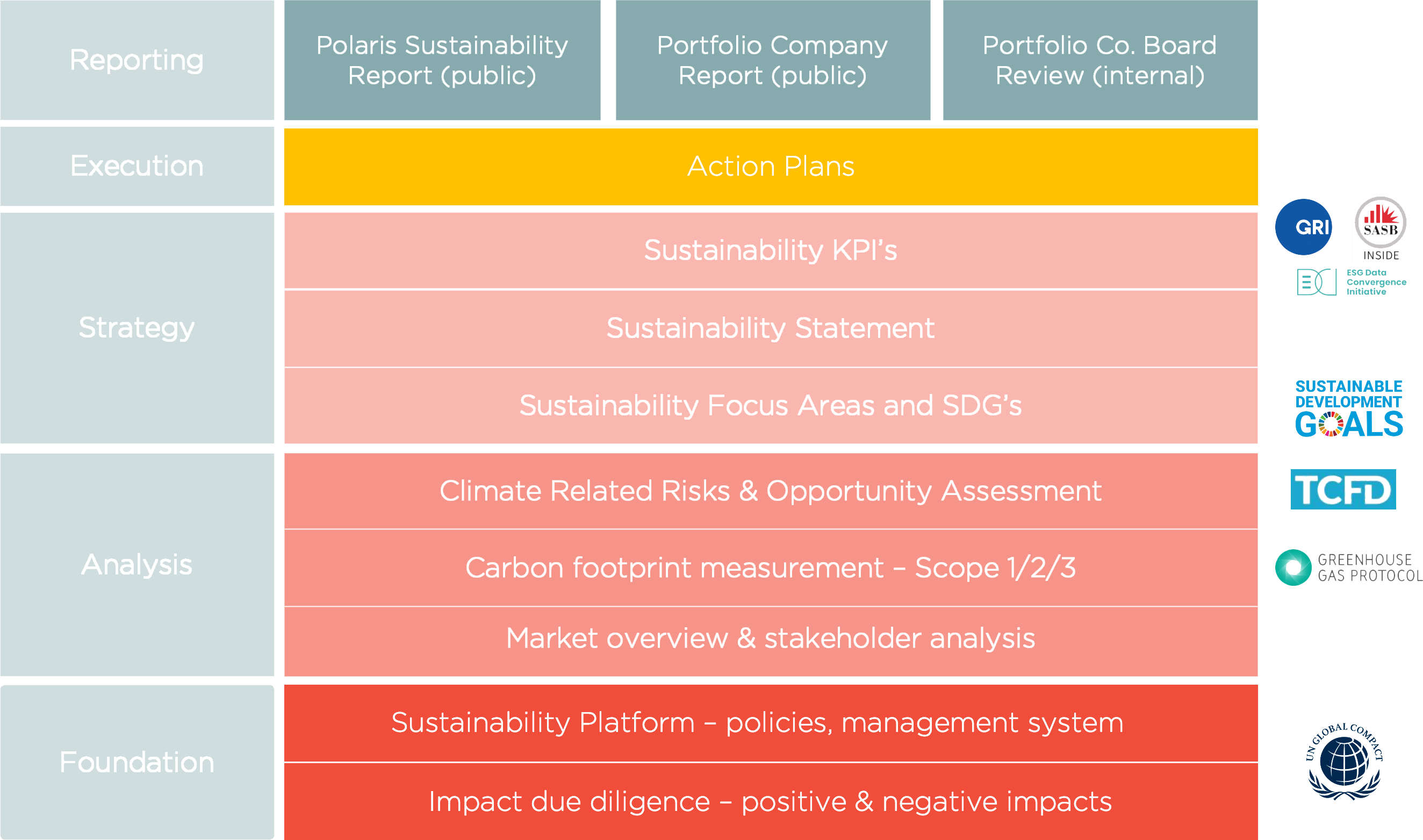
The program consists of the following elements:
- Impact assessment: An assessment of the material positive or positive sustainability-related impacts a company might have according to our Sustainability Principles. Performed from a 'double materiality' perspective in-line with the CSRD.
- Sustainability Platform: Establishment of a sustainability policy including a commitment to UN/OECD guidelines. Implementation of a management system for managing adverse impacts (grievancy mechanism). Establishment of a Code of Conduct for Employees (CoC) and a Business Relationship Code of Conduct (BRCoC) to set expectations on suppliers and other business relationships in line with UN/OECD guidelines. Membership of UN Global Compact.
- Market overview: Structured review of the status of sustainability in the relevant sector, including a review of relevant competitors, peers, customers and suppliers.
- Establishment of carbon footprint baseline: Establishment of a first bottom-up calculation of the company's carbon footprint according to the GHG protocol.
- Climate Related Risks & Opportunities Assessment: Identification of climate related risks & opportunities according to TCFD principles (Task Force on Climate-related Financial Disclosures). Performed for companies considered to be materially impacted by climate change.
- Sustainability Focus Areas and SDG mapping: Identification of the company’s Focus Areas based on the material ity assessment of positive and negative sustainability related impacts across the value chain and related mapping to the UN’s Sustainable Development Goals (SDGs).
- Sustainability Statement: Formulation of sustainability statement detailing what sustainability means for the portfolio company, level of ambition and overall plan going forward.
- Establishment of Polaris standard sustainability KPIs:
-
- Climate Change:
- Carbon footprint: according to Greenhouse Gas Protocol (GHG) on Scope 1, 2 and 3
- Gender Equality:
- Gender distribution for company Board, Management and
at all staff level
- Gender distribution for company Board, Management and
- Working environment:
- Employee turnover: indicator of employee satisfaction.
- Absenteisme (as of new fund PPE VI in 2026)
- Employee satisfaction (as of new fund PPE VI in 2026)
- Health & Safety KPIs for relevant companies (as of new fund PPE VI in 2026)
- Total Recordable Incident Rate (TRIR)
- Lost-Time Injury Frequency Rate (LTIFR)
- Climate Change:
- Establishment of company specific KPIs: Establishment of company specific sustainability KPIs that are material to the portfolio company.
- Action plan: Prioritized implementation plan with initiatives to improve sustainability structures and performance – increasing positive impacts and minimizing negative impacts including action plans to address our three focus areas: Climate change, Gender Equality and Employer responsibility.
- Annual portfolio company board review: Annual update on sustainability to Board of Directors.
- Portfolio company report: Annual sustainability report in-line with the requirements of each portfolio company with respect to time line and content but also in accordance with Polaris minimum standards) published by the company separately or as part of their annual report.
- Polaris Sustainability Report: Reporting from Polaris on sustainability including certain shared portfolio KPIs as part of the regular 'Polaris Sustainability Report'.
We strongly recommend that each of our portfolio companies dedicates a sustainability responsible in the management team, assigns a part/full-time resources to the topic and that 'Polaris Sustainability Program' is approved, and followed-up, by the Board of Directors at least annually. Specialist consultants and Polaris internal resources can support the sustainability responsible employees, management teams and Board of Directors in each portfolio company.
Polaris is subject to a number of regulations and industry practices.
Polaris Management A/S and the funds managed by us in our different investment strategies are subject to a number of regulations and industry practices. We work continuously to monitor and adapt to these to ensure compliance and we engage with external experts to support us in this effort. We also aim to set a good example and promote the development of standards and industry practices related to sustainability in our industry.
Polaris Management A/S is licensed by The Danish Financial Supervisory Authority to operate as an Alternative Investment Fund Manager (AIFM) in accordance with the Danish Alternative Investment Fund Managers Act (Polaris FT number is 23009) and the Alternative Investment Fund Manager Directive Regulation (EU) 2011/61 (“the AIFMD”). Polaris has appointed Private Equity Administrators Depositary Service ApS as Depositary for the Polaris funds.
Polaris Management, our funds and portfolio companies are impacted by the emerging structure of EU regulations on sustainability which are part of the EU Green Deal. As an Alternative Investment Fund Manager (AIFM), Polaris Management and our funds fall under the Sustainable Finance Disclosure Regulation (EU) 2019/2088 (“the SFDR”).
The SFDR sets new standards as to how financial market participants should report on sustainability relating to their financial products. With the SFDR, financial products are divided into categories determined by their level of articulated promotion of sustainability. These categories are defined as Article 6, 8 and 9 financial products. Article 6 products do not consider sustainability as a goal. Article 8 products consider sustainability as a goal, amongst other things, whereas Article 9 products consider sustainability as their primary goal. Article 8 and article 9 products are also termed as “light green” and “dark green” products, respectively.
Our portfolio companies are also directly impacted by regulations with respect to sustainability and sustainability reporting locally in Denmark and Sweden and at the EU level. Depending on their size and classification, they might be directly impacted by the previous Non-Financial Reporting Directive (EU) 2014/95 (“the NFRD”) which is being replaced by the Corporate Sustainability Reporting Directive (“the CSRD”). These EU regulations, the SFDR and the NFRD/CSRD, also operationalize the underlying EU Taxonomy regulation (EU) 2020/852 (“the EU Taxonomy”) as refer to this regulation.
The EU Taxonomy aims to establish a uniform framework as to how environmentally sustainable economic activities are defined. When published in 2020, the EU Taxonomy made amendments to the SFDR, which means that parts of the disclosure regulation refer back to the EU Taxonomy. Hence, the two regulations are interrelated.
Polaris sustainability strategy, which is described in our Responsible Investment Policy and in this sustainability report, is applied to the investment strategies we operated in the period and the active funds under these strategies:
- Polaris Private Equity (PPE). Majority equity investments. Active funds:
- Fund IV: Polaris Private Equity IV K/S
- Fund V: Polaris Private Equity V K/S
- Polaris Flexible Capital (PFC): Junior debt and minority equity investment. Active funds:
- Fund I: Polaris Flexible Capital I K/S
- Polaris Public Equity (PPU): Minority equity investments in listed companies. Active funds:
- Polaris PPE Feeder Fund SICAV
- Other managed funds (since 24th of March 2025)
- Polaris CS Fund I K/S. Closed fund with equity and debt assets managed by PPE and PFC investment teams respectively.
Based on our assessment of the SFDR, and the expected interpretation of this regulation, and the sustainability goals and claims in our sustainability strategy, we believe our current work with sustainability means that our funds fall under SFDR – Article 8. We therefore assume that all our active funds in all of our investment strategies fall under this categorization. Polaris will consequently align disclosures on behalf of our active funds with the requirements for SFDR - Article 8 funds.
On February 26th 2025, the EU Commission proposed the EU Omnibus package with the aim to limit and simplify sustainability reporting mandated through key EU sustainability reporting regulations: the Corporate Sustainability Reporting Directive (CSRD), the Corporate Sustainability Due Diligence Directive (CSDDD) and the EU Taxonomy. Before the EU Omnibus, about two thirds of our companies were eligible to report according to the CSRD in 2026 for the financial year 2025 (Wave 2). This has now initially been delayed by two years and there is also a wide-spread expectation that the minimum size will be increased to a level where almost all of our portfolio companies will be excluded from the CSRD reporting requirements all together. The changes will then most likely reduce the reporting requirements significantly for our current and future portfolio companies. We do however expect that the main principles of the CSRD, and the methodology that has emerged to align with these, will continue to be used and these are also in-line with our general approach to sustainability: identify your material impacts, address these impacts, measure progress and report regularly.
Our commitment to sustainability is executed broadly throughout Polaris and affects our activities throughout our investment process, ownership and exit and covers all our investments. Within the Scope of sustainability, we include social, environmental, and economic impacts according to the internationally agreed principles for sustainable development consisting of the UN Guiding Principles (UNGPs from 2011), and as referenced by the OECD Guidelines (OECD from 2011) and we refer to these as our “Sustainability Principles”. Our sustainability commitment and Sustainability Principles are described in Polaris Responsible Investment Policy (RIP). Our commitment to sustainability includes the promotion of both environmental and social objectives. We ensure that these objectives are reached by following our sustainability strategy described in this report, which includes defined investment criteria and ambitions with respect to sustainability.
The material sustainability related risks and opportunities for each of our investment opportunities and portfolio companies are unique. Which environmental and social factors that should be promoted and improved upon, and how these improvements should be measured, is therefore unique, and will be established on a case-by-case basis, for each portfolio company.
As described in this report, for our three focus areas, we do however systematically follow-up and report on progress, development of Key Performance Indicators (KPIs) and actions taken across our portfolio companies:
We have not identified any general indices to measure our progress against, as our portfolio companies are active in a broad range of industries and geographies.
The EU Taxonomy offers a definition of what constitutes sustainable economic activities, and this definition is expanding to include more areas/sectors. As part of our work on sustainability, we will report on the EU Taxonomy eligibility and alignment of our portfolio companies as required by regulations and integrate this into our work. We have however not yet set any specific investment criteria or performance targets related to the EU Taxonomy.

Our commitment to sustainability is detailed in Polaris Responsible Investment Policy (RIP) and Polaris Sustainability Commitment. It is further elaborated in certain other Polaris policies: our Anti-Corruption Policy, Gender Equality Policy, Privacy Policy and Remuneration Policy. All of these documents are publicly available on our sustainability web-page.
A sustainability risk means, according to the Sustainable Finance Disclosure Regulation (SFDR) “an environmental, social or governance (“ESG”) event or condition that, if it occurs, could cause an actual or potential material negative impact on the value of the investment”. Further, the Corproate Sustainability Reporting Directive (CSRD) states that "A sustainability matter is 'material' when it meets the criteria defined for impact materiality or financial materiality". This is commonly referred to as "Double materiality". Sustainability risks, as well as material sustainability matters as defined by double materiality, are integrated into the investment decisions of Polaris and are taken into account during the investment process in a manner proportionate to each product’s investment objective and in the same way as Polaris approaches other forms of risk management in relation to its products. This is done primarily as part of the due diligence process, whereby should an investment have a material exposure to a sustainability risk or material sustainability matter, Polaris may choose not to make an investment on this basis and in accordance with the relevant investment and risk management policies.
As described in our Responsible Investment Policy, Polaris considers the principal adverse impact on sustainability factors that our investment decisions have in our private equity strategy. Polaris’ investment process consists of several pre-defined “gates”. The due diligence in the final gate consists of several aspects that are to be investigated for the target company. This includes an analysis of the investment from a sustainability perspective. This process is supported by reputable advisors in the area as suitable in each case.
In our private equity strategy, the principal adverse impacts are also evaluated alongside all other risks and opportunities of a potential investment.
If a particular investment fulfills our investment criteria, all risks and opportunities, hereunder sustainability related risks and opportunities, are then fully included in the business plan, the financial forecast and the overall valuation of the company.
It is our ambition that our portfolio companies shall, at a minimum, establish governance structures to meet the requirements embedded in our sustainability principles and in line with good governance principles as referenced in the SFDR. Our sustainability principles are founded on the UNGPs and the OECD’s guidelines that consist of a policy commitment to having a sustainability policy including a code of conduct for employees and suppliers in line with this commitment, sustainability due diligence processes, and grievance mechanisms. The key objective for Polaris is to create value and build a stronger company by active ownership through a structured value creation process, combined with good and effective corporate governance structures. In our private equity strategy, we also address principal adverse impacts through our active ownership and investment restriction activities, as described in our Responsible Investment Policy.
Climate change mitigation means avoiding and reducing emissions of heat-trapping greenhouse gases into the atmosphere to prevent global warming. Climate change adaptation means altering our behavior and systems to protect ourselves from the impacts of climate change (source: WWF). Combating climate change is a focus area in our commitment to sustainability and as a part of this focus we attempt to consider both climate change mitigation and adaptation.
To address mitigation, we measure and work to reduce greenhouse gas emissions throughout Polaris as part of our sustainability commitment. We have also set a Science-Based Target (SBT) for Polaris as a fund manager and submitted this target for approval by the Science Based Target Initiative (SBTI) in June 2025. Polaris’ SBT includes separate portfolio coverage targets for our private equity investments and the funds managed under this strategy (including Scanmetals and Høyer part of Polaris CS Fund I K/S) and our listed equity investments part of Polaris Public Equity. We target 100% portfolio coverage in the end of 2030 for our private equity investments and 50% coverage in the end of 2030 for our listed equity investments (based on the share of eligible Invested Capital in companies with their own SBT approved by the SBTI).
To address climate change adaptation, we consider which investments that are, or will be, materially impacted by climate change and analyze their potential future climate-related risks and opportunities and how these can be addressed. We do this analysis based on the principles provided by the Task force on Climate related Financial Disclosures (“TCFD”), which we integrate into our sustainability strategy. We do however not do TCFD reporting. The analysis of the climate-related risks and opportunities, based on the TCFD principles, are included into our overall assessment of potential investments, as part of our due diligence process, and it is part of Polaris Sustainability Program, which is implemented in our private equity portfolio companies in the portfolio management phase.
The boards of our portfolio companies must establish policies and systems that ensure board oversight with executive management, performance and remuneration reviews. Further, it must ensure legal compliance with respect to books, records, and accounting standards, effective internal controls, and solid risk management processes. Specifically, it is important that the remuneration of the management team and employees in the portfolio company does not encourage risk taking, including sustainability risks, beyond acceptable levels.